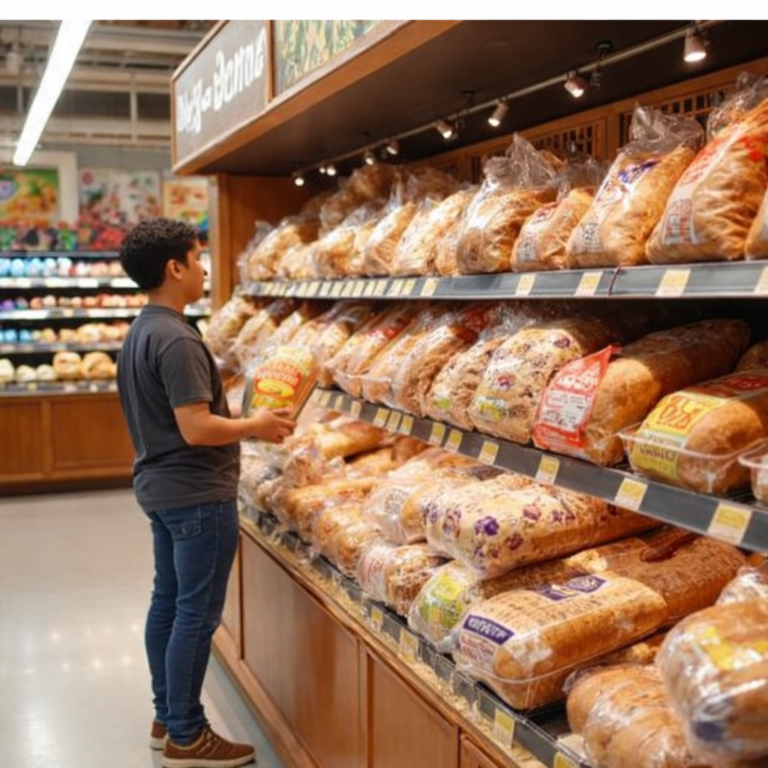
I was standing in the grocery store yesterday trying to pick out a bag of granola for a quick snack. I knew I wanted something without artificial sweeteners or a lot of added sugar, but I didn’t realize how many brands existed until I was staring at an entire wall of them.
Every package promised something different: natural, wholesome, high protein, made with real fruit, heart healthy. At first glance, they all looked like good choices. So I started narrowing them down by reading the front labels… and then flipped them over.
That’s when the headache started.
The back of a food package is packed with long ingredient lists, unfamiliar chemical names, tiny fonts, and complicated nutrition tables. Something as simple as choosing a snack suddenly felt overwhelming.
And that confusion isn’t accidental. Modern food labels are designed to sell first and inform second.
After several minutes of squinting at labels, I put the granola back and walked away empty-handed. But reading a food label doesn’t have to feel like decoding a secret message. With a few simple strategies, you can quickly spot ultra-processed foods, identify hidden additives, and make better choices in seconds.
One of the easiest tools is something called The Rule of 5.
Two Labels on Every Package: The Front vs. The Back
The Front: Marketing
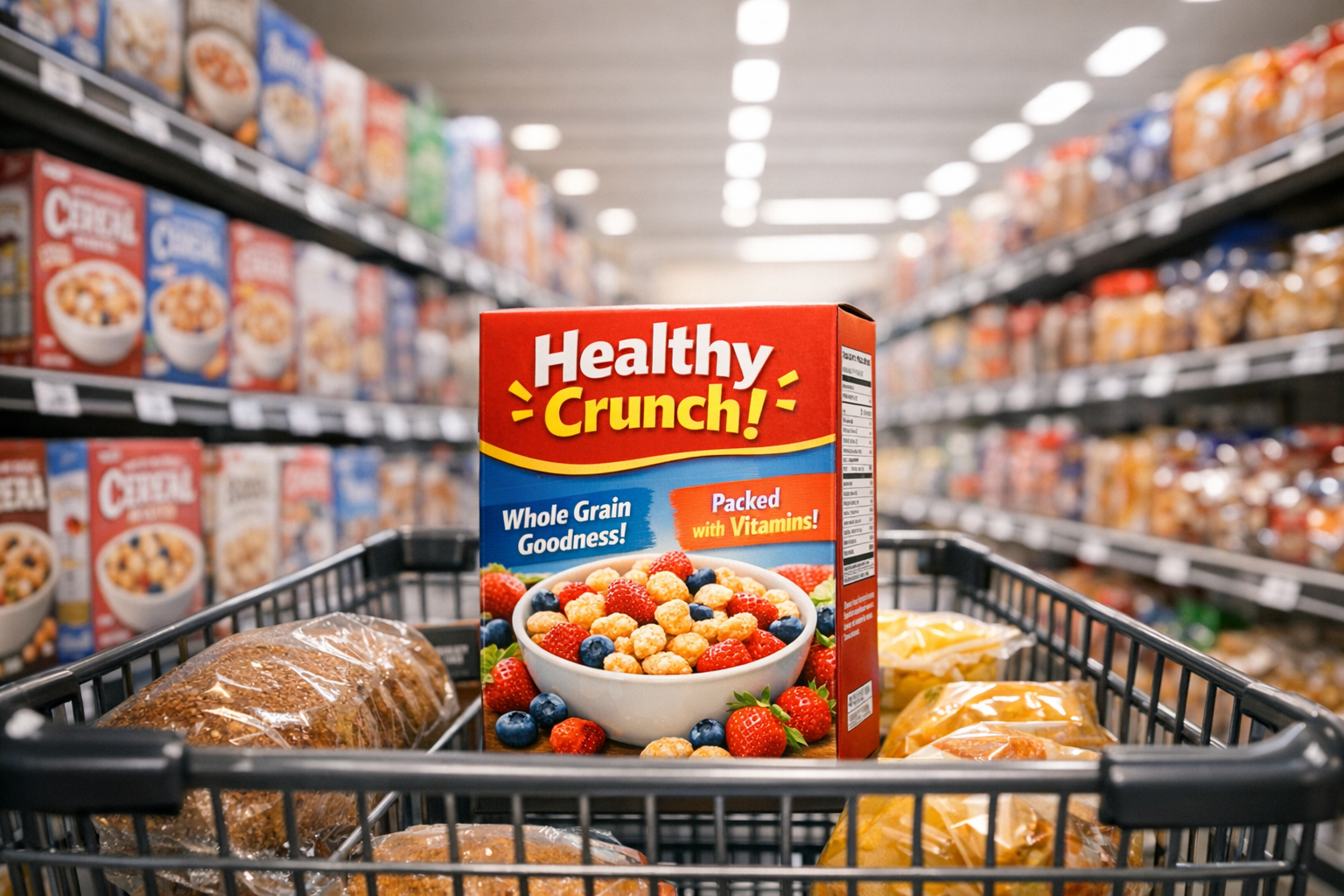
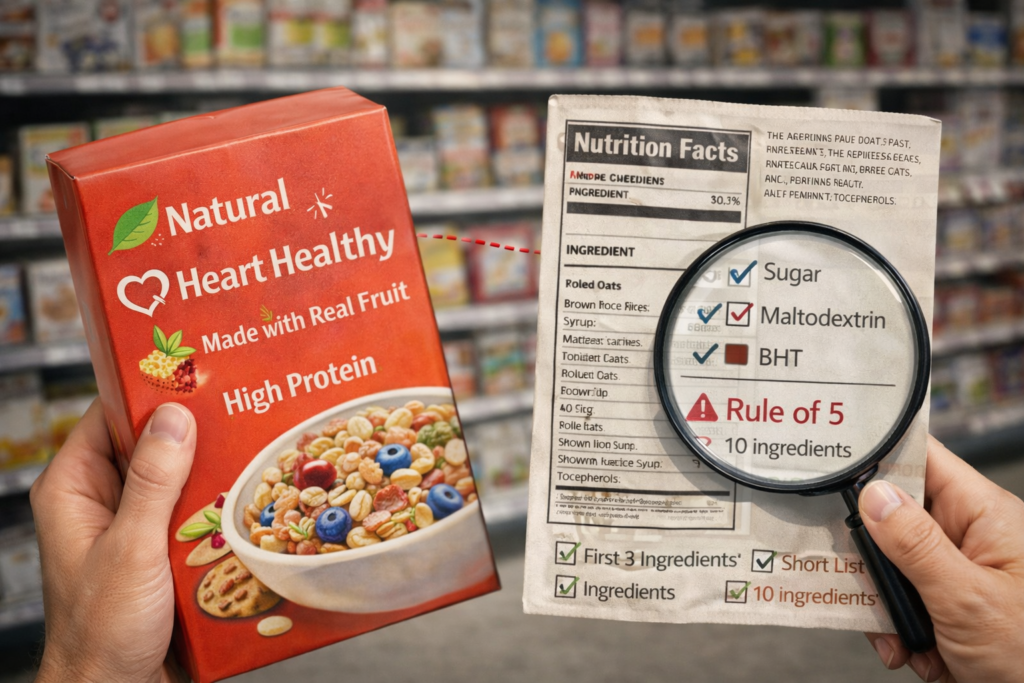
The front of the package is designed to catch your eye. It’s full of buzzwords like “natural,” “wholesome,” “made with real fruit,” “multigrain,” and “high protein.” These terms sound healthy, but many are loosely regulated or essentially meaningless. They create a positive impression before you ever look at what’s actually inside.
The rule of thumb: ignore the front entirely and flip it over.
The Back: Reality
The back contains the ingredient list and the nutrition facts panel. This is where the truth lives. But even here, things can get confusing — long lists, scientific names, and additives you’ve never heard of.
That’s where a simple shortcut helps.
Ingredient List vs. Nutrition Facts
Most people focus on calories, fat, or sugar on the nutrition panel. Those numbers matter. I’ll be the first to admit I check added sugar religiously. But the ingredient list tells the real story. Ingredients are listed by weight, with the heaviest first.
A simple rule: if the first three ingredients concern you, the product should concern you.
The Rule of 5: A Simple Shortcut for Reading Labels
Instead of decoding every ingredient, use this quick filter:
If a product has more than five ingredients, pause and look closer.
It’s not a perfect rule, but it’s a useful gut-check. Here’s why it works.
Why it works
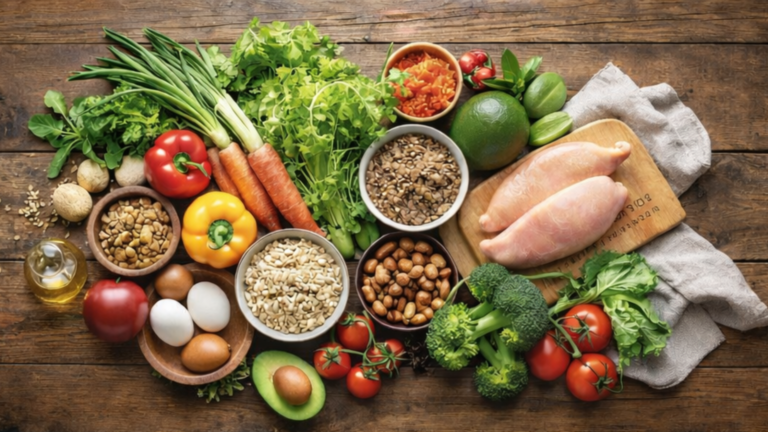
Minimally processed foods usually have very short ingredient lists, often just one or two items:
- Natural applesauce: apples and vitamin C to prevent browning
- Natural peanut butter: peanuts and maybe a little oil
- Pasta: wheat and flour
Compare that with heavily processed packaged foods, where the ingredient list runs several lines and includes stabilizers, preservatives, flavor enhancers, artificial sweeteners, and color additives. The longer the list, the more engineered the food tends to be.
When more than five ingredients is perfectly fine
Some foods naturally have longer ingredients lists without being ultra-processed. A trail mix with six types of nuts and three types of dried fruit is still a whole-food product. The Rule of 5 isn’t about counting ingredients – it’s about noticing what those ingredients are.
Example: Comparing Two Granola Bar Labels
Let’s go back to that granola wall. Here’s what the Rule of 5 looks like in action.
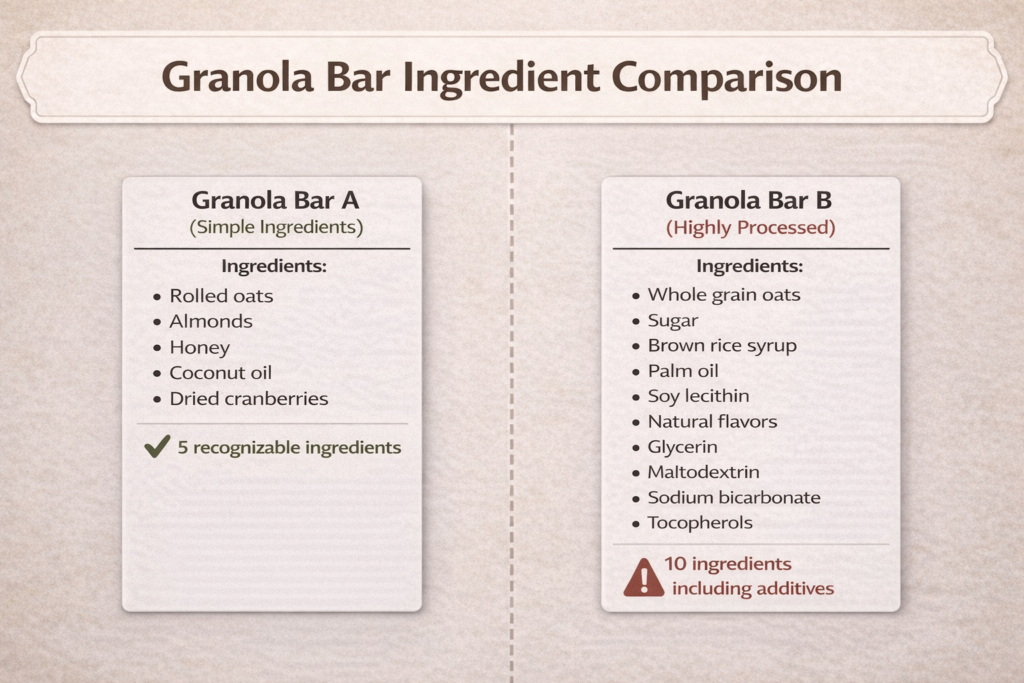
Granola Bar A: Rolled oats, almonds, honey, coconut oil, dried cranberries
Five ingredients. Every one of them is something you’d find in a kitchen.
Granola Bar B: Whole grain oats, sugar, brown rice syrup, palm oil, soy lecithin, natural flavors, glycerin, maltodextrin, sodium bicarbonate, tocopherols
Ten ingredients. Several are additives designed to improve shelf life, texture, and sweetness. Notice that sugar, brown rice syrup, and maltodextrin are all sweeteners, they’re just listed separately so none of them appear too high on the label.
Both bars might look identical on the shelf. The ingredient list tells a very different story. That’s exactly the difference the Rule of 5 helps you notice quickly.
How to Spot Hidden Additives
Manufacturers know consumers are becoming more label-savvy, so they’ve found ways to disguise ingredients, especially sugar.
Hidden Sugars
There are more than 60 names for sugar hiding in ingredient lists. Some common ones to watch for: dextrose, maltose, evaporated cane juice, brown rice syrup, barley malt, fruit juice concentrate, and anything ending in “-ose.” If you see multiple sweeteners listed separately, like our granola bar above – that’s a deliberate strategy to keep sugar from appearing too high on the list.
Emulsifiers and stabilizers
These are the ingredients that keep your store-bought salad dressing perfectly blended for 18 months, or give a packaged muffin that soft, pillowy texture weeks after it was baked. Common ones include carrageenan, polysorbate 80, xanthan gum, and carboxymethylcellulose. They’re not there for your benefit, they’re there for shelf life and industrial consistency.
Researchers have started paying closer attention to these additives. A landmark study found that certain common emulsifiers disrupted the gut microbiome and promoted intestinal inflammation in animal models, with follow-up human studies pointing in a similar direction. The research is still early, but the long-held idea that small amounts of additives are basically harmless is getting a serious second look. We’ll do a full deep-dive on emulsifiers in an upcoming post.
Preservatives
BHA, BHT, and TBHQ are synthetic antioxidants used to prevent fats and oils from going rancid. You’ll find them in crackers, cereals, chips, and fast food packaging. Like emulsifiers, they’re considered safe at current levels but put simply, real food doesn’t need this much help staying fresh.
A Quick Shortcut
If an ingredient ends in “-ose” it’s likely a sugar. If it ends in “-ate” it’s likely a chemical compound. You don’t need to memorize every additive – just recognize the pattern.
The 10-Second Food Label Checklist
When you pick up a packaged food, you don’t need to analyze every number on the nutrition panel. A quick scan of the ingredient list tells you most of what you need to know.
- Ignore the front of the package. Marketing claims are designed to attract attention, not explain what’s inside.
- Flip it over. The ingredient list is where the real information lives.
- Check the first three ingredients. They make up the largest portion of the food. If they concern you, the product should concern you.
- Apply the Rule of 5. A short, recognizable list usually means less processed. A long, chemical-sounding list usually means more engineered.
- Scan for additives. Watch for multiple forms of sugar, emulsifiers, artificial flavors, and preservatives.
If the ingredient list is mostly foods you’d recognize in a kitchen, that’s a good sign. If it reads more like a chemistry exam, that’s useful information too.
The Bottom Line
Food labels can seem complicated, but once you understand that the front is marketing and the back is reality, they become much easier to navigate.
Nobody reads every label perfectly every time, and that’s okay. The goal isn’t perfection. It’s awareness. Even improving three or four of your regular purchases is a real, meaningful win. Label reading is a skill, and like any skill, it gets faster and easier with practice.
If you remember just one thing from this post, let it be this: the fewer ingredients a food contains, the closer it is to real food.