You open a bag of chips and plan to eat a handful.
Ten minutes later, the bag is empty.
You weren’t starving. You weren’t even that hungry.
So what happened?
If you’ve ever felt “out of control” around certain foods, there’s nothing wrong with you and it’s not just about willpower. Ultra-processed foods are created in ways that make them very easy to overeat.
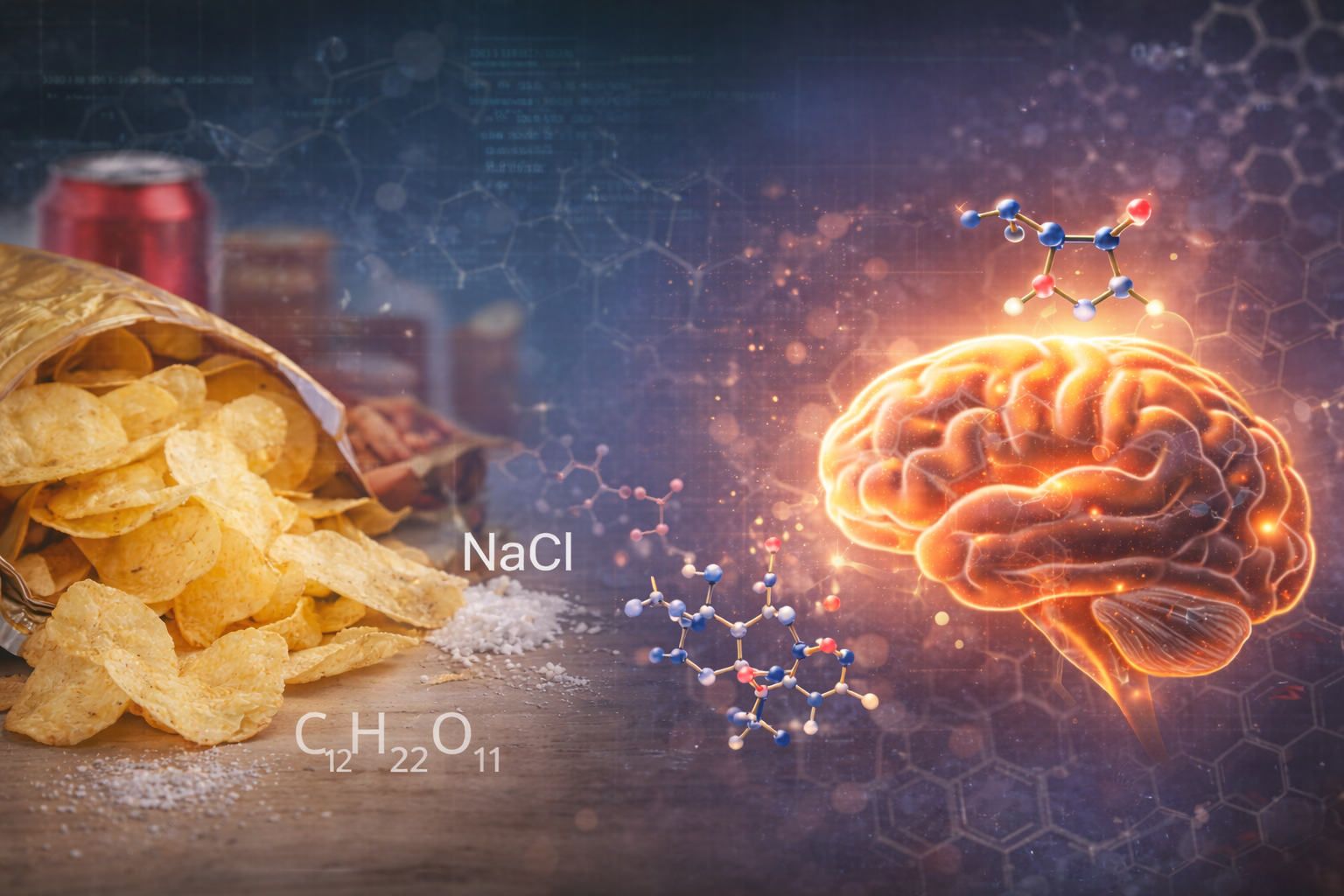
Ultra-processed foods can feel addictive because they are engineered to stimulate the brain’s reward system, combine sugar, fat, and salt in precise ratios, and override natural fullness signals. Once you understand what’s happening inside your brain and body, cravings start to make sense.
What Are Ultra-Processed Foods?
If you’re new here, read my full breakdown of what ultra-processed foods are and how to identify them.
Here’s the short version:
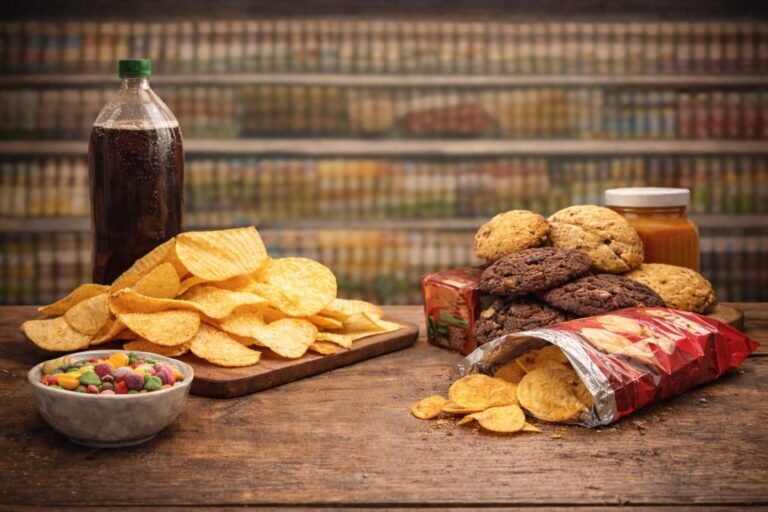
Ultra-processed foods are industrially manufactured products made mostly from refined ingredients, additives, and flavorings rather than intact whole foods. They’re designed to be convenient, highly palatable, and shelf-stable.
They’re often low in fiber and protein and contain little to no intact natural ingredients.
Examples of Ultra-Processed Foods
- Packaged chips and crackers
- Sugary breakfast cereals
- Soda and energy drinks
- Candy and snack cakes
- Instant noodles
These foods often contain little to no intact whole food.
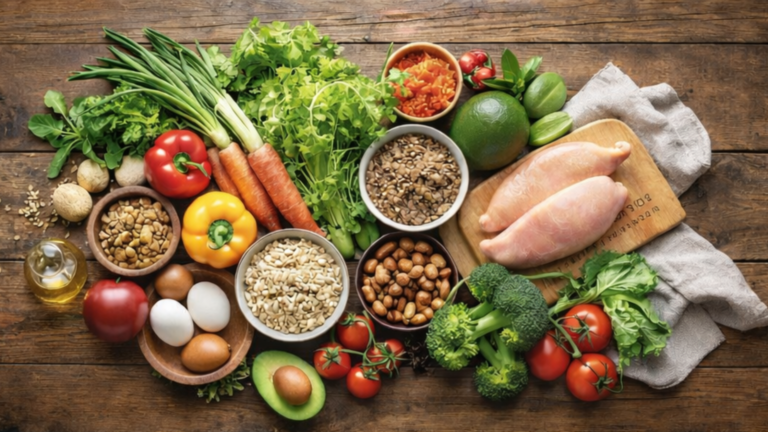
What Counts as Real or Minimally Processed Food?
Whole or minimally processed foods look like:
- Eggs
- Fruit
- Beans
- Plain yogurt
- Fresh meat
- Vegetables
They contain recognizable ingredients. They aren’t formulated for maximum “craveability.”
At Simple and Unprocessed, this distinction matters. Because once you see the difference, your cravings begin to make more sense.
Why Are Ultra-Processed Foods So Hard to Stop Eating?
Ultra-processed foods tend to:
Trigger strong dopamine responses
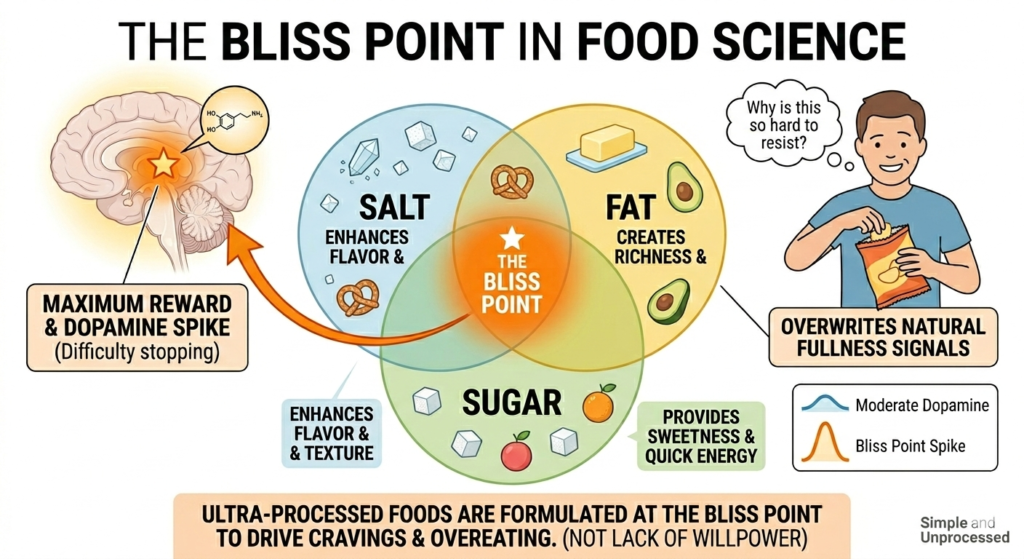
Hit the brain’s “bliss point”
Be very easy to overeat
Disrupt natural fullness signals
Let’s walk through this simply.
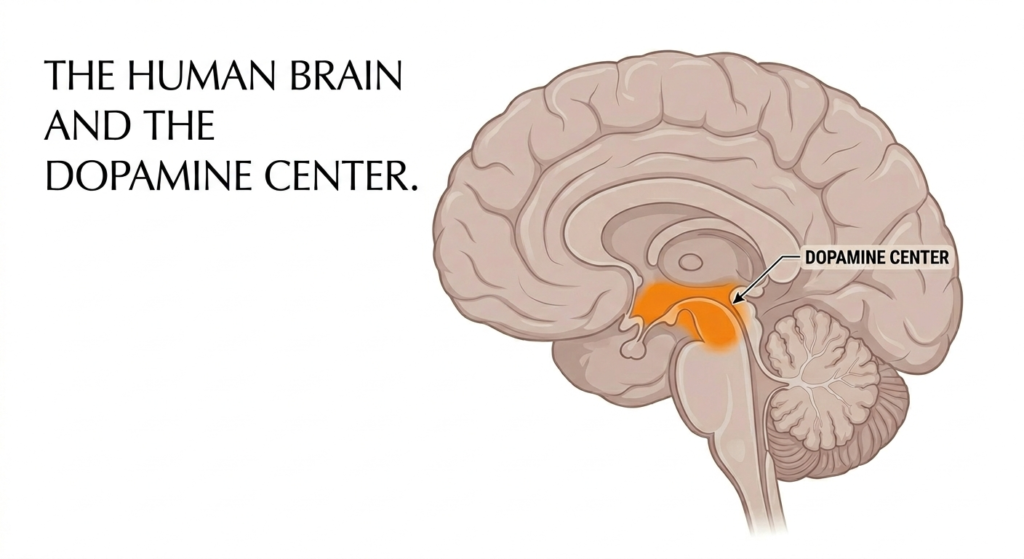
Dopamine and the Brain’s Reward System
Dopamine is often called the “pleasure chemical,” but it’s more accurate to think of it as a motivation and learning chemical.
When you do something that supports survival, like eating, your brain releases dopamine to reinforce the behavior.
It’s your brain saying:
“That worked. Remember it.”
What Happens With Whole Foods?
If you eat an apple:
- You get sweetness
- You chew
- You digest fiber
- You feel gradually satisfied
The dopamine response is moderate and regulated.
What Happens With Ultra-Processed Foods?
Now imagine:
- French fries (fat + salt + crunch)
- Chocolate cake (sugar + fat + soft texture)
- Soda (rapidly absorbed liquid sugar)
These combinations create a much stronger reward signal. Instead of a gentle rise, you get a sharper spike and your brain pays attention.
Over time, your brain begins associating certain foods with powerful reward, and it starts seeking them automatically.
The Bliss Point and Engineered Flavor
Ultra-processed foods aren’t accidentally delicious. Food companies invest heavily in research to identify ideal combinations of sugar, salt, and fat.
One researcher, Howard Moskowitz, helped popularize the concept of the “bliss point.”
What Is the Bliss Point?
The bliss point is the precise level of sweetness, saltiness, and richness that maximizes pleasure without overwhelming you.
Not too sweet.
Not too salty.
Just enough to keep you reaching for another bite.
That’s why it’s hard to overeat baked potatoes but easy to polish off a container of fries.
When flavors are perfectly calibrated, your brain gets excited. I know my brain gets that feeling with Oreos. I take out three, and before I know it, half the bag is gone.
Nothing is wrong with us. Our biology is reacting to a finely engineered flavor profile.
Why Ultra-Processed Foods Are Easy to Overeat
Texture matters more than we realize.
Ultra-processed foods are often:
Crunchy
Creamy
Soft
Easy to chew
Quick to swallow
The Speed Factor
Your brain takes about 20 minutes to register fullness.
If food is high in calories, low in fiber, and easy to eat quickly, you can consume a large amount before your body catches up.
You can drink three sodas in minutes. Try eating six oranges in that same amount of time.
Whole foods slow down your eating.
Ultra-processed foods speed things up.
Speed + pleasure + convenience often equals overeating.
How Ultra-Processed Foods Disrupt Fullness Signals
Whole foods contain:
- Fiber
- Protein
- Water
- Volume
These stretch the stomach and activate satiety hormones.
Ultra-processed foods are often:
- Low in fiber
- Low in protein
- Calorie-dense
You can eat 800 calories of chips and still feel unsatisfied.
But 800 calories of potatoes, chicken, and vegetables?
You’ll likely feel physically full.
If you overeat ultra-processed foods, it doesn’t mean your body is broken. It means your natural signals are being overridden.
Are Ultra-Processed Foods Really an Addiction?
This is still debated.
Some researchers note that ultra-processed foods can trigger behaviors that resemble addiction:
- Cravings
- Loss of control
- Continued use despite negative consequences
- Strong reward responses
Is it identical to drug addiction? No.
But there’s enough overlap that many researchers take the comparison seriously.
If you’ve ever thought:
“I can’t stop once I start.”
“I crave it even when I’m not hungry.”
“Why did I eat that? Now I feel guilty.”
You’re not alone. Many people’s brains react to these foods in ways that mimic addictive patterns.
The TV + Snack Trap

You sit down to watch something.
You bring a bag of chips.
You’re relaxed, distracted, maybe tired.
The food hits the bliss point. Dopamine reinforces the behavior. Distraction mutes fullness cues. The food is easy to eat quickly.
Before you realize it, the bag is empty.
This isn’t a character flaw.
It’s biology interacting with the environment and engineered food.
Why This Isn’t About Willpower
It’s easy to blame yourself.
But large food companies invest heavily in:
- Food science
- Consumer psychology
- Sensory testing
- Marketing research
Products are developed for:
- Repeat purchase
- Maximum palatability
- Convenience
- Emotional association
They’re inexpensive.
Widely available.
Heavily marketed.
Socially normalized.
Ultra-processed foods aren’t hard to resist because you lack discipline. They’re hard to resist because they’re designed to be.
You’re navigating an environment that makes overconsumption easy. Understanding the system helps you work with your biology instead of fighting it.
How to Reduce Cravings for Ultra-Processed Foods
The goal isn’t perfection.
It’s awareness.
It’s small shifts.
It’s making choices that support your biology.
Don’t Just Remove - Replace
If you simply cut something out, your brain keeps asking for it.
Instead of:
“I can’t have chips.”
Try:
“What can I eat that will actually satisfy me?”
Examples
Craving crunch?
Try roasted potatoes, popcorn, nuts, or sliced apples with nut butter.
Craving something sweet?
Try fruit with yogurt, dates with peanut butter, or a square of dark chocolate.
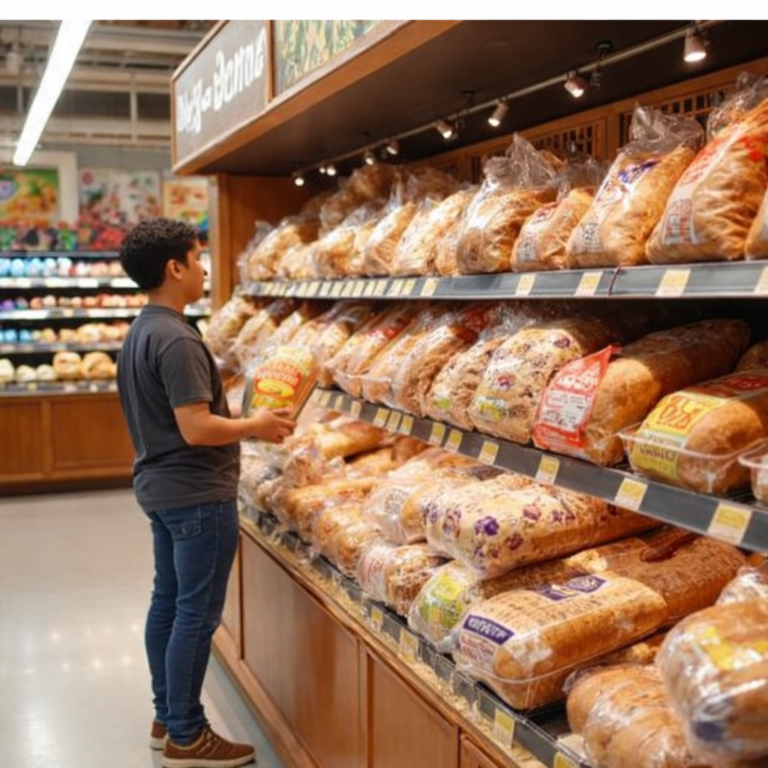
Keep more minimally processed foods in your home environment and reduce how often ultra-processed foods enter your grocery cart.
Over time, taste buds recalibrate. Cravings soften. Food feels simpler.
Not perfect. Just more balanced
Frequently Asked Questions
Are ultra-processed foods addictive like drugs?
They don’t affect the brain exactly like drugs, but they do strongly stimulate the brain’s reward system. For some people, this can create craving patterns that resemble addictive behaviors.
Why can’t I stop eating chips once I start?
Chips combine fat, salt, crunch, and rapid consumption speed. This combination hits the bliss point, spikes dopamine, and delays fullness signals, making it easy to overeat before your body catches up.