One of the things nobody warns you about when you start cutting back on ultra-processed foods is how many habits come with them.
It’s not just the snacks you grab on the go or the frozen meals you heat up on a busy Tuesday night. It’s the things that feel like traditions. The routines that have become part of who you are as a family. Those are the hardest ones to look at honestly, because they don’t feel like processed food habits. They feel like traditions.
In our house, Saturday morning breakfast is one of those things.
When I was little my father used to make a special Saturday morning breakfast. It continued that when my boys were small, a big hot breakfast that nobody was in a hurry for. No school, no rushing out the door, a change from the weekday mornings.
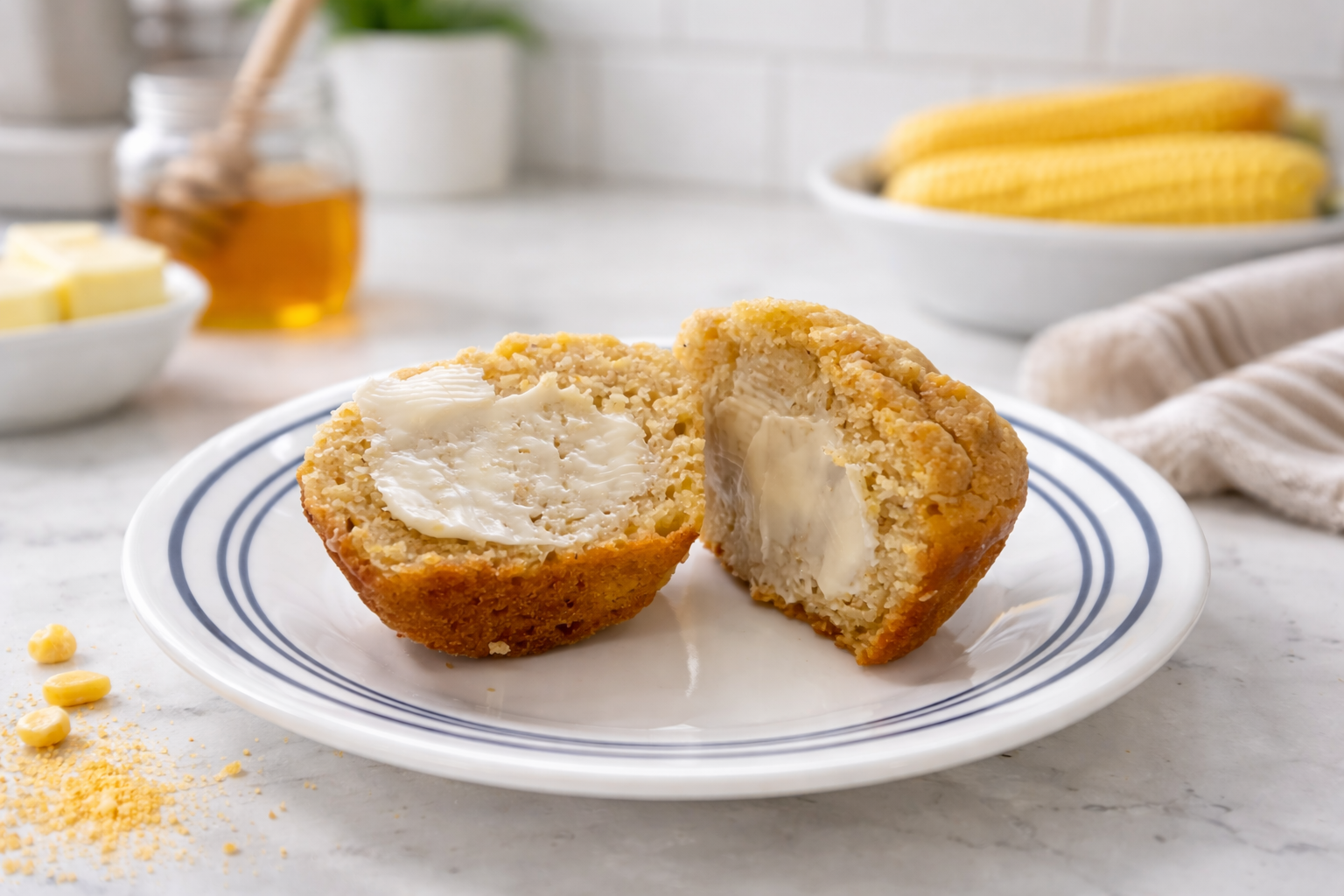
The corn muffins were always part of it. My boys loved them. I loved making them. It felt wholesome. It felt like exactly the kind of thing a good Saturday morning should be.
And then I flipped the box over.
The Moment the Ingredient List Changed Everything
You already know what I found, because if you’ve been reading this blog, you’ve started flipping boxes over too. Corn syrup. Emulsifiers. Artificial flavors. A list long enough to give you pause on what was supposed to be a simple, comforting thing. Our family’s favorite brand, the one we’d been reaching for without a second thought for years, was exactly the kind of product we were trying to move away from.
So I did what I always do. I went looking for something better.
It wasn’t a secret ingredient. It wasn’t extra sugar. It was a technique, one that bakers were using in the 1800s, long before anyone needed a box mix to make a good corn muffin. Something most modern recipes have completely forgotten about. It produces a muffin that is more tender, more flavorful, and naturally sweeter than anything that ever came out of that box.
And it starts with something called scalding.
The Old Baking Technique Most Modern Recipes Forgot
Scalding is the reason your grandmother’s corn muffins tasted better than the ones from a box.
Before processed food made convenience king, home bakers in the 1800s poured boiling water or hot milk directly over their cornmeal and let it sit before mixing the batter. It sounds almost too simple to matter. But that single step transforms cornmeal in a way that no amount of added sugar can replicate. It releases the natural sweetness from the grain itself, softening the texture, and producing a muffin with a tender, almost creamy crumb.
No corn syrup. No refined sugar. Just a little honey, some applesauce, and a technique that’s been quietly sitting in old cookbooks for 200 years waiting for someone to rediscover it.
These muffins are proof that real food doesn’t need a lot of help. It just needs a little patience and the right technique.
What Scalding Actually Does
When you pour boiling liquid over dry cornmeal and let it rest, something interesting happens at the molecular level.
It Releases Natural Sweetness
The heat breaks down the starch granules in the cornmeal, a process called gelatinization. This process unlocks natural sugars that were already present in the grain but essentially locked away.
The result is a measurably sweeter flavor without a single extra gram of added sugar. You’re not adding sweetness, you’re releasing it.
It Improves Texture
The hot liquid also pre-hydrates the cornmeal, which means the bran in the grain softens completely before it ever hits the oven. In a standard recipe, those tiny bran particles stay relatively firm and can cut through the gluten structure as the muffin bakes, giving you that sometimes dry, crumbly texture that cornbread is notorious for. Scalding eliminates that problem entirely. The bran is already soft by the time the batter comes together, which produces a muffin with a noticeably more tender, cohesive crumb.
It’s one technique doing two jobs: more sweetness and better texture and it costs you nothing but about fifteen minutes of patience.
Why Modern Recipes Skipped This Step
The short answer is that the processed food industry made it unnecessary, at least on paper.
Why wait fifteen minutes for cornmeal to hydrate and release its natural sweetness when you could just add two tablespoons of sugar and call it done? Why develop a technique when an ingredient could replace it? This is the same logic that gave us boxed cornbread mix, which solves the texture problem with emulsifiers and solves the sweetness problem with corn syrup, and produces something that is recognizably cornbread but is also a fundamentally different food than what people were eating 150 years ago.
The irony is that the old technique produces a better muffin. Not better in a nostalgic, rose-colored-glasses way, better in a way you can actually taste. The sweetness from scalded cornmeal has a depth and subtlety that added sugar can’t replicate, because it’s coming from the grain itself rather than sitting on top of it.
Scalding fell out of home kitchens the same way a lot of traditional techniques did, not because something better came along, but because something faster did.
And faster isn’t always better. This recipe is a pretty good argument for that.