If you read my last post about how to read a food label, you already know how this story starts. I was standing in the granola aisle, hoping to find something I could feel good about eating on its own or spooning over yogurt in the morning. Simple enough, right?
Not exactly.
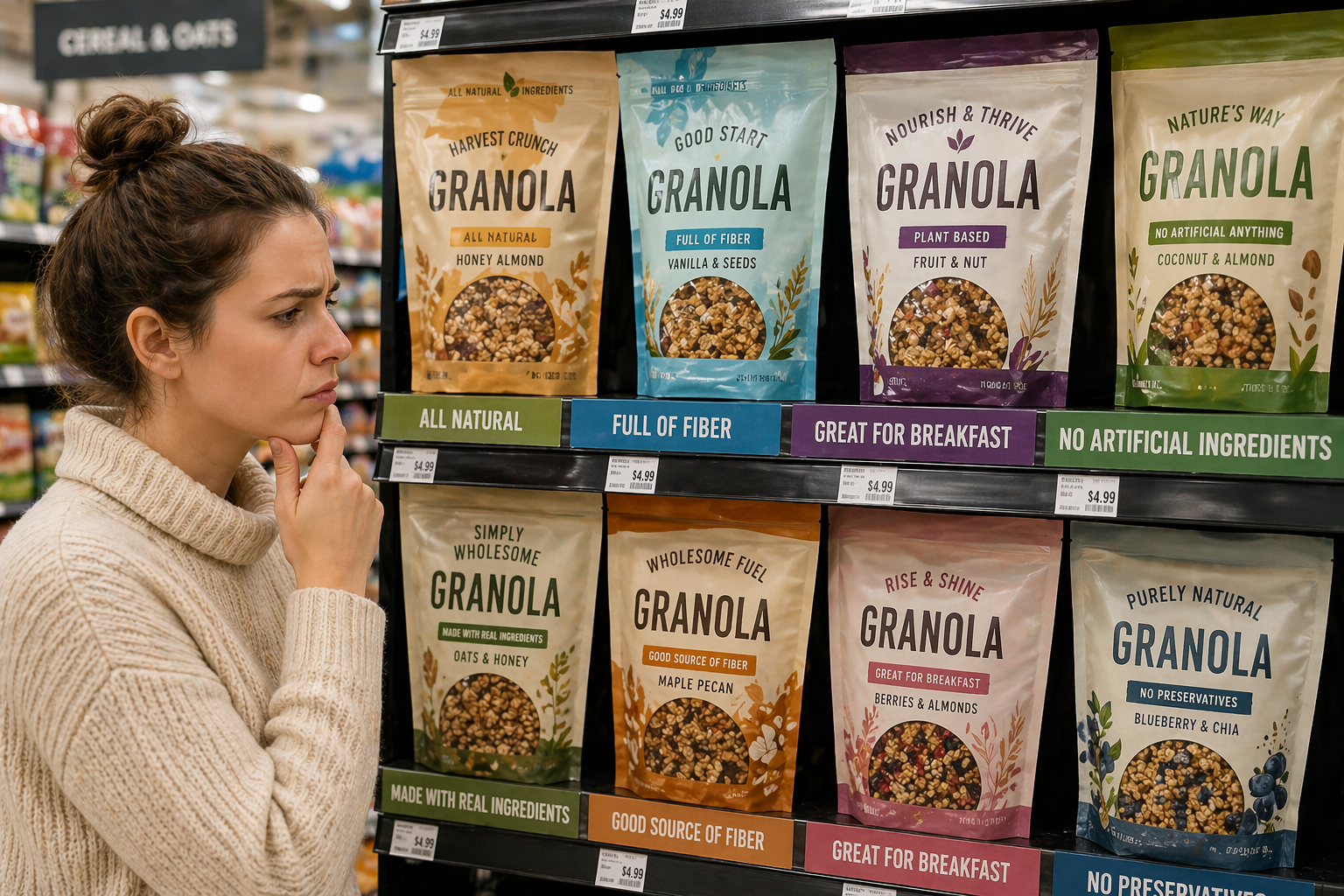
The aisle was overwhelming. There had to be twenty to thirty options staring back at me, each one with a front label doing its very best to look like the healthy choice. Natural. Wholesome. Made with real ingredients. No artificial flavors. I did what I’ve learned to do, I ignored the front, started picking up bags, and flipped them over.
That’s when the frustration set in.
It wasn’t just the long ingredient lists, though those were bad enough. It was the sugar. It was right there in black and white on every single bag I picked up — the added sugar line on the nutrition panel telling me exactly how much had been dumped in. And then there were the ingredients themselves, full of the -ose endings and alternate sugar names I’d been learning to spot. Brown rice syrup. Dextrose. Maltose. Evaporated cane juice. Sometimes two or three of them in the same product.
I stood there for a good ten minutes. I picked up bag after bag. I put every single one back.
I went home empty-handed and went straight to my kitchen, or really my computer to do research..
If I couldn’t find granola I trusted, I was going to make it myself. Something where I knew every single ingredient, where the sweetness came from real sources in amounts I was comfortable with, and where I wasn’t funding a chemistry lab with my grocery bill.
After a little experimenting, this is what I came up with.
What Makes This Granola Different
Before we get to the recipe, it’s worth talking about what’s actually in this and why.
The base is straightforward — rolled oats, a mix of nuts, coconut flakes, and sunflower seeds. Real ingredients you could pick up and eat on their own. Nothing hiding behind a name you can’t pronounce.
The sweetener is honey, and not very much of it. Half a cup spread across a batch that makes roughly ten servings keeps the sugar content genuinely low while still giving the granola a subtle, natural sweetness. A cup of unsweetened applesauce does double duty here, it adds a little natural sweetness of its own while also acting as a binder, which means you need less oil than most granola recipes call for.
The coconut oil keeps everything from sticking and helps the oats toast evenly without needing a heavy coating of fat. It also brings a nutritional bonus worth mentioning. Coconut oil contains medium-chain triglycerides, or MCTs, a type of fat that the body processes differently than the long-chain fats found in most vegetable oils. MCTs are sent directly to the liver where they’re used quickly for energy rather than being stored as fat. Some research also suggests they support healthy cholesterol levels and have antimicrobial properties. It’s still a fat and still calorie-dense, so a little goes a long way but it’s a far better choice than the refined vegetable oils you’ll find in most commercial granola.
And then there’s the ingredient that might surprise you.
Egg whites.
Whipping egg whites to soft peaks and folding them into the granola before baking is the secret to getting that satisfying cluster texture, the kind of granola that holds together in your yogurt instead of just becoming a pile of loose oats. The egg whites coat everything, and as they bake at low heat they create a light, crispy bond between the oats and nuts without adding any flavor of their own.
It’s a small extra step. It makes a big difference.
A Note on the Sugar
This granola is intentionally low sugar compared to anything you’ll find on that store shelf. If you pick up a bag of commercially made granola, you’ll commonly find anywhere from 12 to 20 grams of added sugar per serving. This recipe has a fraction of that, and what sweetness is there comes from honey, applesauce, and the natural sugars in the dried fruit.
That means it won’t taste like the granola you’re used to from a bag. It will taste like oats and nuts and a little honey — which is exactly what it is. Most people find that after a few days their palate adjusts, and the commercial stuff starts tasting almost uncomfortably sweet by comparison.
Give it a week. You’ll see what I mean.
The Bottom Line
Ten minutes in that granola aisle taught me something I keep coming back to, if you can’t find what you’re looking for on the shelf, the answer is usually simpler than you think. This recipe takes about an hour start to finish, most of which is the oven doing the work. You end up with a big batch that keeps for two weeks in an airtight container, costs less per serving than the name brands, and contains exactly what you put in it.
No -ose endings. No chemistry lab. Just granola.